From a church bell rung before sunrise in 1810 to thousands of voices shouting “¡Viva México!” in Los Cabos, Independence Day is more than a date on the calendar. It is one of the moments when Mexico stops, gathers and remembers exactly who it is.
On the night of September 15, something happens across Mexico.
Plazas fill. Flags appear from balconies, car windows and storefronts. Families squeeze around tables loaded with pozole, tostadas, tamales and enough salsa to test everyone’s courage. Mariachi, banda and regional music spill into the streets. Children wave tiny Mexican flags. Someone inevitably arrives wearing an enormous sombrero.
And then, for a few moments, everyone waits.
A bell rings.
Names from more than two centuries ago are called out.
And thousands — sometimes hundreds of thousands — answer with the same words:
¡Viva México!
For a visitor, Mexican Independence Day can look like one enormous party.
For Mexicans, it is something deeper.
In 2026, Mexico is celebrating the 216th anniversary of the beginning of its struggle for independence, a movement that started in the early hours of September 16, 1810.
But understanding the holiday means understanding that Mexico is not simply celebrating something that happened 216 years ago.
It is celebrating Mexican identity itself.
The Shout That Started a Revolution
The story begins in the small town of Dolores, Guanajuato.
In 1810, Mexico did not yet exist as the independent nation we know today. The territory was New Spain, governed under Spanish colonial rule.
A group that included priest Miguel Hidalgo y Costilla, military officer Ignacio Allende and other conspirators had been discussing rebellion. Among the best-known figures connected to that movement was Josefa Ortiz de Domínguez, whose warning that the conspiracy had been discovered helped force the insurgents to act sooner than planned.
Before dawn on September 16, Hidalgo had the church bell rung in Dolores and called people together.
What followed became known as the Grito de Dolores — the Cry of Dolores.
There is no perfect transcript of exactly what Hidalgo said that morning. The polished version repeated at modern celebrations came later. What historians do know is that the moment ignited a rebellion that became a long and complicated war.
Mexico’s independence was not won that night.
The struggle continued for 11 years, finally reaching its consummation in 1821.
That distinction matters.
September 16 celebrates the moment people were willing to begin the fight.
And perhaps that is one reason the story has remained so powerful.
So Why Does Everyone Celebrate on September 15?
This is one of those wonderfully Mexican questions that confuses almost every first-time visitor.
Mexico’s official Independence Day is September 16.
But the biggest party happens the night before.
Today, the Grito ceremony is reenacted on the evening of September 15 in plazas throughout the country. In Mexico City, the president rings the historic Campana de Dolores from the National Palace as crowds gather in the Zócalo.
The original bell associated with Hidalgo’s call to rebellion was transferred to the National Palace in 1896 and incorporated into the national ceremony.
By that period, festivities on the evening of September 15 had become firmly woven into the national celebration. The night evolved into the extraordinary combination of civic ceremony and street party that exists today.
At midnight?
The party is already well underway.
And No, It Isn’t Cinco de Mayo
We have to clear this one up.
Especially for our readers visiting from the United States.
Cinco de Mayo is not Mexican Independence Day.
May 5 commemorates the Mexican army’s victory over French forces at the Battle of Puebla in 1862.
Important history? Absolutely.
Mexico’s Independence Day?
No.
That is September 16.
Ask someone in Mexico which celebration carries the greater national significance and September’s Fiestas Patrias are in an entirely different category.
September is even known as Mes Patrio — the patriotic month.
By the beginning of the month, Mexico practically changes color.
Green. White. Red.
Everywhere.
What “¡Viva México!” Really Means
This is where the holiday becomes difficult to translate.
Because ¡Viva México! technically means something close to “Long live Mexico.”
But standing in a Mexican plaza on September 15, that translation feels inadequate.
The response is emotional.
It is pride.
It is belonging.
It is grandparents and grandchildren standing in the same plaza.
It is remembering people who came before you.
It is regional identities — Oaxacan, Jalisciense, Sinaloense, Sudcaliforniano and dozens more — temporarily folding themselves into one enormous Mexican identity.
Mexico’s own cultural institutions describe the Fiestas Patrias not simply as historical commemorations, but as opportunities to recognize the country’s diverse cultural expressions and the traditions that make up Mexican identity.
And modern Mexico is enormously diverse.
There is no single Mexican food, accent, musical tradition or way of celebrating.
That is part of the point.
For one night, Mexico celebrates all of it.
Independence You Can Taste
Naturally, Mexico manages to turn history into dinner.
And what a dinner.
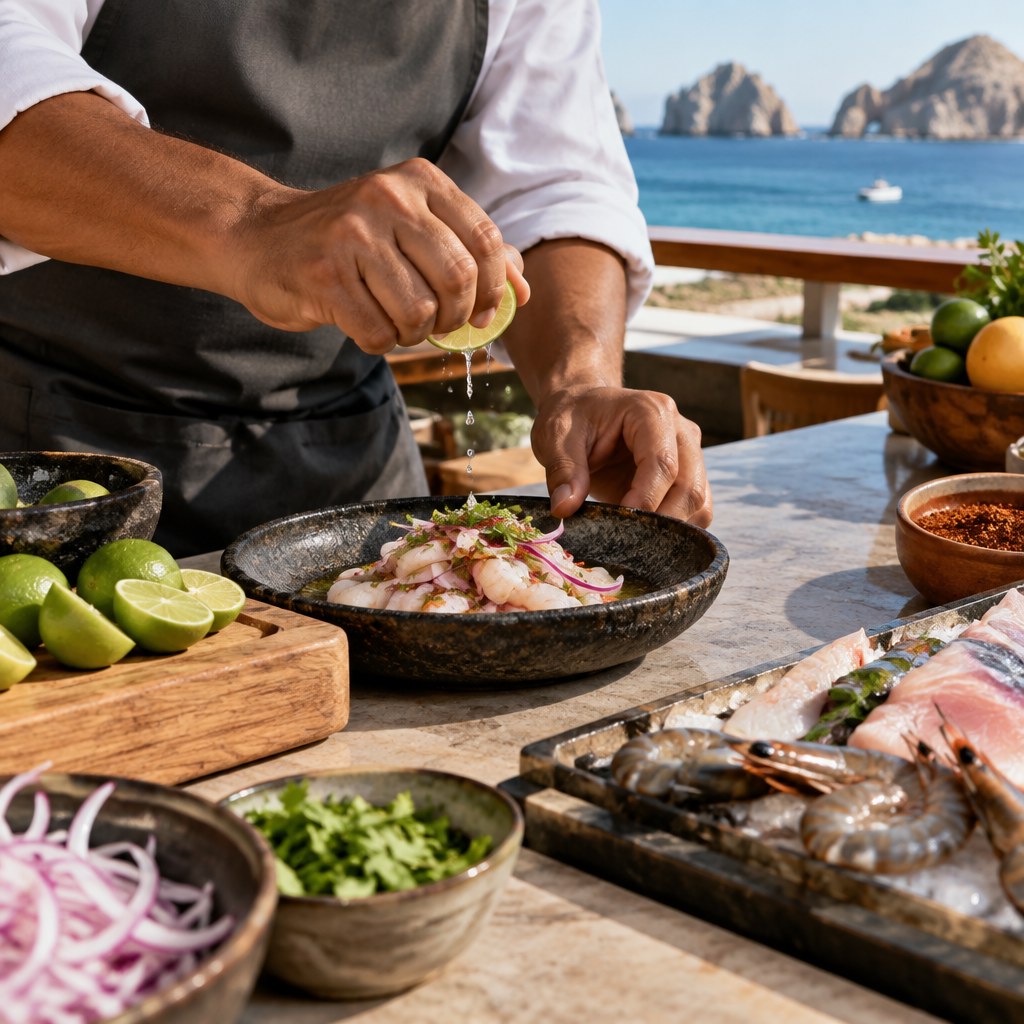
September brings out some of the country’s most beloved foods: pozole piled high with radish, lettuce and lime; tostadas; tamales; enchiladas; tacos; pambazos; mole; and chiles en nogada.
The latter may be Mexico’s most photogenic patriotic dish.
A poblano chile is traditionally filled with a savory mixture, covered in pale walnut sauce and topped with red pomegranate seeds and green parsley — creating the colors of the Mexican flag right on the plate.
Food has become inseparable from the Fiestas Patrias because the celebration usually happens where much of Mexican life happens:
Around a table.
The Mexican government itself describes Independence festivities through that familiar combination of family, food, fireworks and tradition.
Of course, a respectable celebration may also require tequila.
Or mezcal.
Possibly both.
We are journalists. We don’t make the rules.
The Grito Comes to Los Cabos
Here in Los Cabos, the celebration has its own distinctly Baja personality.
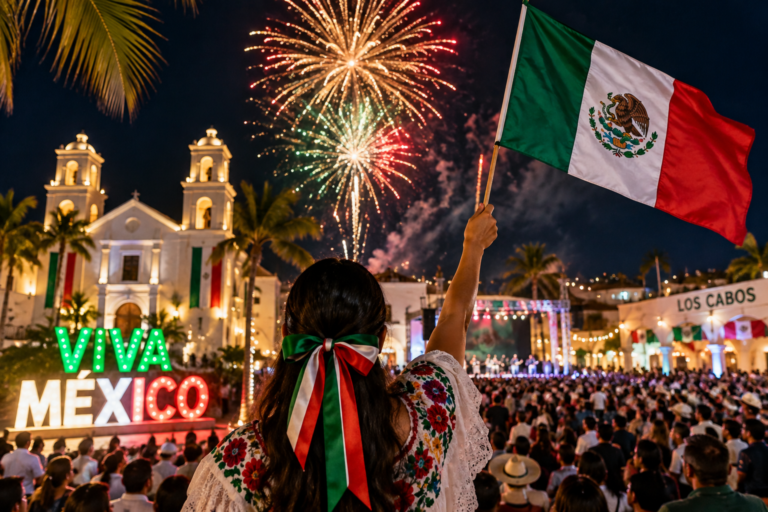
On September 15, 2026, thousands of families gathered at Plaza Teniente José Antonio Mijares in San José del Cabofor the municipality’s commemoration of the 216th anniversary of the Grito.
At 10 p.m., the traditional ceremony took place from the Municipal Palace, followed by fireworks. Celebrations were held simultaneously in San José del Cabo, Cabo San Lucas, Miraflores, Santiago and La Ribera.
Cabo San Lucas continued the commemoration on September 16 with its civic-military parade, involving local schools and civil organizations.
For travelers who know Los Cabos primarily for beaches, golf courses, resorts and margaritas overlooking the Sea of Cortez, nights like this reveal another Cabo.
A community.
Families who have lived here for generations.
Children learning traditions their parents learned from theirs.
A Baja California Sur that existed long before Los Cabos became one of the world’s most famous vacation destinations.
That may be one of the best reasons for visitors to experience a local Grito at least once.
You aren’t watching a performance created for tourism.
You are being invited into a Mexican tradition.
The Women Behind Independence
For generations, the popular telling of Mexican independence focused heavily on a handful of male heroes.
The historical picture is much larger.
Women served as organizers, messengers, financiers, intelligence gatherers and active participants throughout the independence movement.
Among the best known are Josefa Ortiz de Domínguez, Leona Vicario, Gertrudis Bocanegra, Antonia Nava and Rita Pérez, alongside countless women whose names never became part of the standard history books. Mexican historical institutions have increasingly highlighted those contributions when recounting the independence movement.
That changing understanding of history makes the modern Grito interesting.
Tradition remains.
But the story Mexico tells about itself continues to grow.
A Country Celebrating Itself
There is plenty of pageantry surrounding Mexican Independence Day.
The flags are enormous.
The fireworks are loud.
The music is louder.
And if there is pozole nearby, someone will insist that this particular recipe is better than every other pozole in Mexico.
Do not get involved.
Some battles are unwinnable.
But underneath the fun is something remarkably sincere.
Mexican Independence Day is a yearly reminder that a country is more than territory or government.
It is memory.
Language.
Recipes.
Songs.
Families.
Arguments.
Traditions.
Neighborhood plazas.
Regional pride.
And millions of individual stories somehow gathered beneath the same green, white and red flag.
More than two centuries after a bell rang in Dolores, Mexicans still gather each September and answer that sound.
Not quietly.
Never quietly.
¡Viva México!