In a country where cash has long been king, Mexico may be approaching a turning point.
As President-elect Claudia Sheinbaum prepares to take office, conversations around modernizing the country’s payment systems are gaining traction—particularly at everyday touchpoints like gas stations and highway toll booths. While no official nationwide mandate has been enacted to eliminate cash, the direction is becoming increasingly clear: Mexico is steadily, and strategically, moving toward a more digital economy.
A System Already in Transition
Across Mexico’s federal highways, drivers have likely noticed the shift. Toll operators such as Caminos y Puentes Federales (CAPUFE) have expanded the use of electronic payment systems like IAVE and TAG, allowing vehicles to pass through designated lanes without stopping.
These systems are not new—but their growing presence signals a deeper priority: efficiency.
Long lines at toll booths, especially in high-traffic corridors like those leading into Los Cabos or Mexico City, have made digital lanes not just convenient, but necessary. In some locations, cash lanes are already being reduced or deprioritized during peak hours.
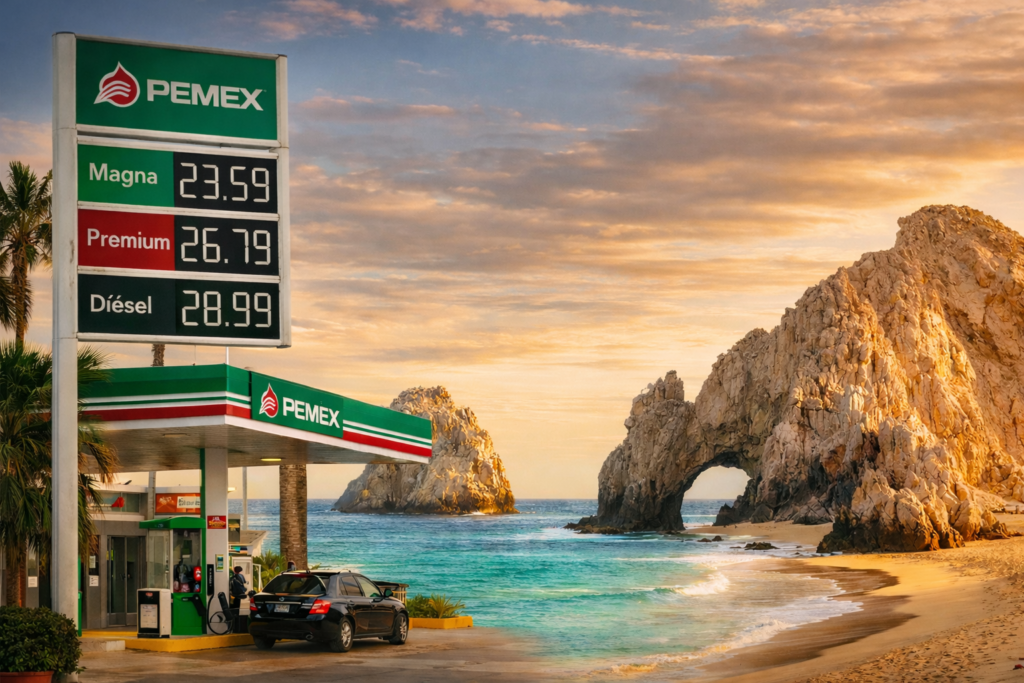
At gas stations, a similar evolution is underway. Petróleos Mexicanos (Pemex), along with private fuel providers, has increasingly adopted card terminals, contactless payments, and digital invoicing systems tied to Mexico’s tax authority. For many urban consumers, paying with cash is no longer the default—it’s becoming the exception.
The Government’s Digital Push
Behind these changes is a broader national strategy.
Institutions like Banco de México have been actively promoting platforms such as CoDi, a QR-based payment system designed to allow instant, commission-free transactions directly from bank accounts. Combined with SPEI, Mexico’s real-time interbank transfer system, the country already has the infrastructure for a largely cashless environment.
The motivation is multifaceted:
- Reduce tax evasion through traceable transactions
- Improve security by limiting cash handling
- Increase efficiency across transportation and retail systems
- Expand financial inclusion through accessible digital tools
For a government focused on modernization and transparency, these are not small incentives—they are foundational.
So, Is Cash Being Eliminated?
Not yet.
Despite growing speculation, there has been no formal announcement or legislation confirming the complete elimination of cash payments at gas stations or toll booths nationwide. Any transition of that scale would require significant infrastructure upgrades and careful consideration of Mexico’s economic realities.
Roughly a third of the population still relies heavily on cash, particularly in rural regions and informal sectors. For millions, digital banking is not yet fully accessible or trusted.
What is far more likely—and already happening—is a gradual shift:
- More cashless-only express lanes on highways
- Increased digital payment incentives
- Continued expansion of contactless and app-based transactions
What It Means for Los Cabos and Travelers
For destinations like Los Cabos, where international tourism plays a major role, the shift toward digital payments could be largely seamless. Many visitors already rely on credit cards, mobile wallets, and prepaid toll tags.
However, the transition will still matter.
Travelers driving rental cars along the Transpeninsular Highway may increasingly encounter toll booths favoring electronic payment. At gas stations, having a backup payment method—beyond cash—will become less of a convenience and more of a necessity.
For locals and property owners, particularly those managing multiple vehicles or frequenting toll roads, adopting digital systems may soon save not just time, but frustration.
A Quiet but Defining Shift
Mexico is not eliminating cash overnight. But it is building a system where cash is no longer essential.
And that distinction matters.
Rather than a sudden policy change, what’s unfolding is a gradual redefinition of how everyday transactions work—one that prioritizes speed, transparency, and modernization without forcing an abrupt break from tradition.
In the coming years, the question may no longer be whether Mexico will go cashless—but how quickly the rest of the country will catch up to where it’s already heading.